Which Insect in the Wasp Family Is Very Small but Stings Like a Yellow Jacket
- Stinging
- Contact
- Biting
- Precautions
- Photo Credits
When insects, mites and ticks bite, they oft inject saliva to digest the tissue and help in the feeding process. Your body's reaction to the components of the saliva causes the itching, redness and swelling that is associated with these bites. In improver to the saliva, insects and scorpions that sting and spiders that seize with teeth often inject venom, which is used to subdue casualty or protect themselves. This venom usually produces a painful reaction in people. Bees and wasps that alive in colonies can assault in large numbers, potentially exposing victims to dangerous amounts of venom. These insects typically cause the nigh problems when they perceive their nest is threatened.
For most people, a single sting will cause pain, swelling and stiffness (if the sting was in a joint). The discomfort may concluding merely a few minutes or for one or more days. Some people can develop more than serious reactions. Swelling may involve an unabridged arm or leg, last several days or require hospital treatment.
A third type of reaction is called "anaphylactic shock." In a few people, the immune system goes "wrong," and within minutes later on receiving a sting they may develop: (a) nausea and constriction in the breast; (b) difficulty breathing and swallowing; (c) a drib in claret pressure; (d) blue colour in the pare (due to lack of oxygen); and, in extreme cases, (e) unconsciousness or death.
People who develop more than merely the normal symptoms from a single sting should see their physician almost the need to be desensitized. People concerned well-nigh experiencing severe reactions to stings should consider the need to carry an allergy first-aid kit with them when afield.
Stinging
Bees, wasps, hornets, fire ants and scorpions that inject venom from the tip of their belly are sometimes considered beneficial because of their importance in pollination or in preying on other pest insects. However, anyone who has ever been stung by one of these creatures will ordinarily recall otherwise. After being stung, it is important to immediately remove the stinger and venom sac if they are present at the sting site. This can be done with a fingernail, the edge of a credit card or tweezers. Immediate removal volition end venom from being released. Avert squeezing the venom sac. Wash the site with lather and h2o and apply cold compresses to relieve hurting and swelling. For more pronounced reactions, apply hydrocortisone cream or calamine balm to reduce itching and swelling. If itching and swelling are bothersome, have an oral antihistamine like diphenhydramine (Benadryl) or chlorpheniramine (Chlor-Trimeton). For severe reactions, seek immediate medical attention.
Home remedies include applying wet salt to the site within five minutes of beingness stung. Leave the common salt in place for xxx minutes. In theory, the table salt will draw the venom from the wound. Similar results have been obtained with moistened tobacco, wet baking soda or wet aspirin. These abode remedies have non been proven scientifically, but won't hurt you if yous cull to use them.
The Lonely Stingers
The cicada killer, mud dauber and scorpion are solitary creatures and are usually encountered one at a fourth dimension. They are not-aggressive but will sting if provoked or trapped against bare skin. Their food consists of spiders and insects.
Types
Cicada Killers:
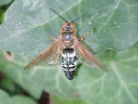 Cicada Killer
The cicada killer is a large wasp that varies in length from 1 to 1.five inches and is black or rusty colored with yellow bands on the abdomen. This wasp nests in burrows in the ground and provisions its nest with one or ii paralyzed cicadas for the developing larvae. Nesting usually occurs in sod-covered areas only the grass is not harmed. The solitary adult is oft seen hovering 1 to 2 feet above the ground near the entrance to its nest.
Mud-daubers:
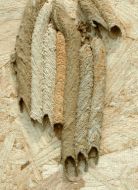 Pipe Organ nest
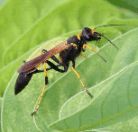 Pipe Organ mud-dauber
Pipe-organ mud daubers are elongated, slender and usually shiny-black wasps that vary in length from about a half inch to an inch or more. These wasps make their mud nests with the cells bundled in the form of long tubes, hence the common "pipe organ" name. Private wasps make a buzzing sound equally they shape mud into a nest and provision it with spiders for their larvae to feed upon during evolution. The female person wasp stings and paralyzes the wasp and then lays an egg on it and seals it in the mud tube. The nests are frequently in protected only open areas nether the roof eaves of buildings and sheds or in garages. Mud daubers rarely sting and are generally considered beneficial in reducing spider populations.
Scorpions:
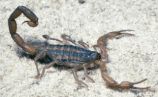 Scorpion
Scorpions are plant across the state. The abdomen is broadly joined to the head area and is differentiated into two parts: a wide seven-segmented front portion and a much narrower v-segmented rear portion that terminates in a stinger. Scorpions prefer to nest under rocks, tree bawl, boards, garbage cans and rubbish piles. Those found in Georgia are about ii inches long and the hurting of the sting is like to that of a bee or wasp.
Control
Chemical controls are usually non necessary or appropriate for the lonely stingers. Turf areas can be treated with insecticides labeled for these sites to discourage nesting of cicada killers. Scorpions can be killed with an application of insecticide, but eliminating their convenance areas is more effective and long-lasting. There is non a expert insecticide registered for control of mud daubers. Mud daubers are non aggressive and their nests can usually be physically destroyed with little danger from the wasp.
The Social Insects
Bees, wasps, hornets and ants develop colonies where there may be a few dozen to thousands of individuals with a queen, workers and an elaborate social structure. These are the social insects. While well-nigh individuals are not-aggressive, all volition sting if handled. The social bees, wasps and hornets are a greater stinging threat than the lone pests because they will attack in large numbers if they perceive their nest is in danger. Those that make a paper nest construct them of establish fiber and salivary secretions. In the fall, when temperatures reject and food becomes scarce, the female person wasps and hornets oftentimes enter homes for hibernation.
Types
Beloved Bees:
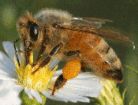 Love Bee
One of the most widely known social insects, the honey bee was brought to this land from Europe many years ago. Most colonies are managed in manmade hives, but escaped swarms often nest in hollow trees, wall voids and attics. Dear bee colonies concluding several years with the queen and workers overwintering in the hive. A queen may live several years. Individual honeybees are encountered across their nest when they are collecting nectar and pollen from blossoms. People usually get stung while walking barefoot across a lawn that has blooming clover or dandelions, or if a bee gets trapped between clothing and skin.
Bumble Bees:
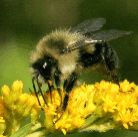 Bumble Bee
Most people are familiar with this big, buzzing, furry, yellow and black bee that can produce a very painful sting. The yellowish pubescence on the abdomen differentiates bumble bees from carpenter bees, which have a smoothen and shiny black abdomen. Similar yellow jackets and hornets, only fertilized females hibernate during the winter and each starts a new nest during the bound. Nests are usually constructed in cavities in the soil previously used past field mice. The opening to the nest will often have fresh soil effectually it as a result of digging activities. People are ordinarily not stung unless they disturb the nest.
Umbrella Wasps (Polistes Wasps):
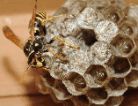 Umbrella Wasp on Nest
Umbrella wasps, also called polishes wasps, are dusky brown with various orangish markings. They construct an open up paper nest suspended from a short stalk. Wasps that build their nests under the eaves of houses, on porches, in attics or in dense shrubbery can go a trouble. A new nest is made each year, initiated by a fertilized overwintering queen. These wasps feed themselves and their immature on caterpillars. Nests are small compared to those of yellow jackets and hornets and incorporate upwards to about 250 wasps.
Yellow Jackets:
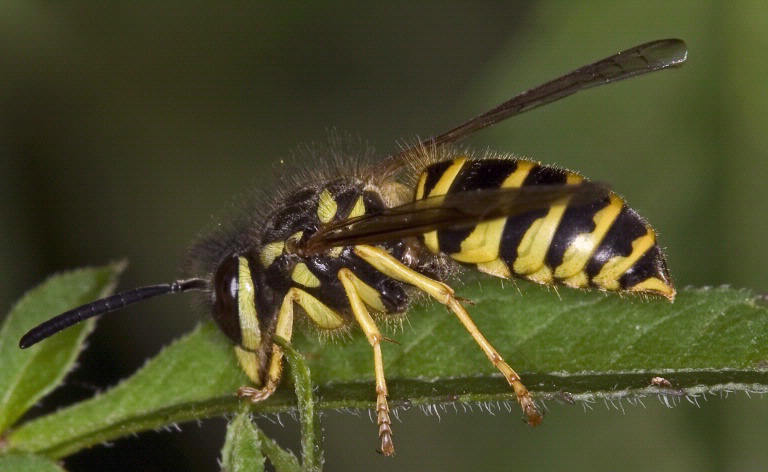 Yellow Jacket
Yellowish jackets are small (half-inch-long) wasps marked with black and yellow banding. Colonies are initiated by overwintering queens that make paper nests underground, but occasionally they will use hollow trees, wall voids and attics or branches over a stream. A fully developed nest may contain from a few hundred to many thousand adults. Yellow jackets feed on a diversity of pest insects, but will besides forage for meat or soft drinks at picnic, camp and garbage sites. This addiction often brings them into close association with people. Adept sanitation in picnic areas can assistance reduce bug with these pests. Solitary scavenging yellow jackets are usually non-ambitious unless handled, but become very aggressive every bit a grouping if their nest is threatened. Yellow jackets volition vigorously pursue an intruder who threatens their nest and are generally considered the most unsafe of the social insects.
Baldfaced Hornets:
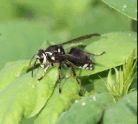 Baldfaced Hornet
The white or light yellowish markings on the confront, thorax and part of the abdomen assist to identify the baldfaced hornet. These hornets are actually a type of yellow jacket that build their nests suspended in copse and bushes. The nest looks like a "bloated football game" high off the ground in a tree or bush. Usually, in that location is a unmarried entrance opening at the lower terminate of the nest. These hornets are widespread, having been institute in 46 states, Canada and Alaska.
European Hornets (Giant Hornets):
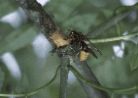 European Hornet
The European hornet (also known every bit the giant hornet) is large (over 1 inch long), with its head and thorax a characteristic nighttime brown with yellow markings on the abdomen. Paper nests are constructed in hollow tree trunks, buildings and occasionally in the ground or in the aeriform environment. The European hornet chews the bawl off living plants, such as lilacs, to make paper for its nest and is attracted to ripening fruit, meat and sweets. This hornet tin can be attracted to lights on summer evenings, only they are not ordinarily a problem unless their nest is near human action.
Burn Ants:
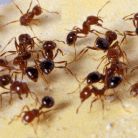 Fire Ants
Burn down ants are now the most mutual and troublesome ant in the southeastern United States. These pests were introduced into the Port of Mobile in 1918 and take spread from Texas to the piedmont of Northward Carolina. Many native emmet species have been displaced by these pests. Superficially, fire ants look much like ordinary house and garden ants. As with wasps and hornets, fire ants inject venom from the tip of the abdomen. Their sting causes a swollen, cherry-red area with a blister that fills with a pus-like material and heals slowly. A single fire ant mound may contain upward to 200,000 workers.
Control
Most social bees, wasps and hornets are benign and should not be controlled unless their nest and activities are shut to humans and create a take chances. For bees, wasps and hornets, apply an insecticide in the evening when the insects are at rest. With the wind at your back and an escape route selected, aim the insecticide at nest openings in copse, bushes, under eaves, ground cracks and crevices in and around nest openings. Re-treatment may be necessary. If possible, destroy the nest or seal the nest opening.
Readily available insecticides include a multifariousness of formulations of aerosols for quick knockdown and kill. Some aerosols produce a jet stream of up to 20 anxiety for operator safety and the ability to reach nests high off the ground. For honey bees nesting in buildings, command procedures are more complicated. Colony removal services are available for a fee. Contact your Extension agent for more information.
For fire ants, treat individual mounds when they are freshly rebuilt subsequently rains. Pour an insecticidal deluge over a mound so that the mixture will suspension the surface; do non stir the mound. Use ane to 2 gallons for an average (12- to 14-inch diameter) mound. Granular and bait formulations are also available.
Contact Irritants
Caterpillars with venomous spines
The caterpillars of some moths have sharp, hollow spines or hairs that contain venom. Contact with these spines causes a called-for inflammation of the skin, only can be more serious when in contact with a mucous membrane or the eyes. The spines from dead caterpillars are all the same problematic. Almost of these caterpillars feed on the leaves of various hardwood trees and shrubs and contact with people is uncommon. The venomous spines are a defense machinery and the colorful patterns or unusual body shapes serve as a alarm to their enemies. Well-nigh 25 species accept spines that tin can be painful. Iii of the more common species are described below.
Types
Puss Caterpillars:
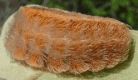 Puss caterpillar
Puss caterpillars may be pale yellowish, greyness or blood-red brown, nigh 1 inch long and densely covered with hairs. Among these hairs are hollow spines with venom. Stings on the paw can cause the unabridged arm to swell and become numb. Later, there can be severe pain followed by itching. Young children are often more than severely affected. Large population increases in local areas can cause a problem.
Saddleback Caterpillars:
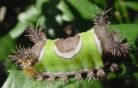 Saddleback caterpillar
The saddleback caterpillar is approximately 1 inch long and has a chocolate-brown sluglike body with a light-green mid-department. In the heart of the green mid-section at that place is a distinctive brown saddle mark with a white edge. Venom-filled spines are located on fleshy "knobs" on all sides of its body. Contact with this caterpillar's spines can be extremely painful and severe reactions are possible for sensitive individuals.
Hag Moth Caterpillars:
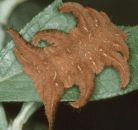 Hag Moth caterpillar
The hag moth caterpillar is a strange-looking brownish caterpillar with 6 pairs of curly projections, 3 long and three short, coming from the flattened body. The plume-like projections on its back project out to the sides, suggesting the disarranged hairs of a hag. Among the brown hairs on the projections are longer black stinging hairs. These caterpillars are alone and can easily exist mistaken for leafage debris.
Control
Control is usually not needed since contact is uncommon and these caterpillars are usually solitary. If a number of stinging caterpillars are seen feeding on the foliage around areas where children are active, spray the leafage with an insecticide labeled for tree and shrub application. Recollect, dead caterpillars can still cause painful stings. Spread a material or plastic sheet under a tree or shrub to collect the fallen dead caterpillars, and then advisedly dispose of them.
Bitter
Mosquitoes, flies, fleas, ticks, chiggers and spiders can all produce irritating and sometimes painful bites. The hurting and irritation is usually associated with the puncture from the bite, the saliva injected to aid feeding or the venom injected by spiders.
Flying Insects
Types
Mosquitoes:
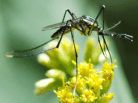 Mosquito
There are more than lx species of mosquitoes in Georgia, many of which will feed on people. The female mosquito must have a blood meal earlier her eggs will develop. Eggs are laid near or on the water, depending on the species. The eggs hatch into larvae or "wigglers." These develop into pupae or "tumblers" and the developed emerges from the pupa. The egg-to-adult transition can occur in vii to 10 days. Female person mosquitoes will range from 300 feet to 20 miles or more in search of a blood meal, depending upon the species. Almost can fly at least ane mile from a larval habitat. Nearly, simply not all, females adopt to feed in the evening. The saliva they inject helps to keep claret from coagulating as they feed. Information technology is too an irritant responsible for some of the itching and swelling people experience after they are bitten. The larvae of mosquitoes that bite at dawn and dusk often develop in ditches, ponds, temporary pools, marshes and swamps. The larvae of mosquitoes that seize with teeth during the day often develop in artificial containers, such as tires, buckets and various litter and debris, particularly in the northern part of Georgia.
Deer and Horse Flies:
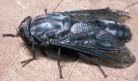 Horse Fly
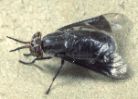 Deer Fly
Deer and horse flies are strong fliers and a serious nuisance of warm-blooded animals and people. Only the females demand a blood meal. Their mouthparts are bladelike and it is painful when they cut through the skin. When the blood is flowing from the wound they will "lap" it upwardly. The larvae feed in a broad diverseness of moisture or damp sites that are high in organic material. Most females feed during the warmer parts of the solar day, but some species prefer the hours at dawn or dusk. Horse flies are larger than deer flies and commonly have clear wings, while the deer fly has dark markings on the wings.
Biting Midges, "No-see-ums," "Punkies" and "Sand Flies":
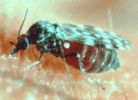 Biting Midge
(no-meet-ums)
These pests are very small-scale flies (about i/32 to to 1/xvi-inch long) whose small, bladelike mouthparts make a painful wound out of proportion to its tiny size. Welts and lesions from the seize with teeth may last for days. The larvae of various species develop in a wide variety of damp or moisture places high in organic matter. Almost are attracted to lights. 1 vicious biter develops along the Atlantic declension in salt marshes and wet soil. Some other species, found in mountainous areas, feeds in the evening and night hours and is small enough to pass through ordinary screens. These are important pests in coastal and mountainous areas and can seriously interfere with outdoor activities.
Black Flies (Buffalo Gnats):
 Black Wing
Black flies, also known every bit buffalo gnats, are pocket-size (i/16- to 1/viii-inch long), bloodsucking flies that are usually black to grey in color. They typically bite in shaded or partially shaded areas and may fly every bit far every bit 15 miles or more from a larval habitat. The larvae are found attached to underwater objects in fast-flowing sections of rivers and streams. For this reason, they can be very troublesome in mountainous areas. The saliva injected while feeding causes swelling and soreness that may persist for days.
Control
Considering of the widespread larval habitats and long flying range of most mosquitoes, deer and horse flies, biting midges and black flies, control by homeowners is non always practical. Aerosols can be used indoors for occasional invaders. For twenty-four hours-biting mosquitoes, the emptying of artificial containers as a larval habitat tin can reduce bitter since these mosquitoes only fly a few hundred feet from these sites. Plough over, puncture, cover with plastic or store potential larval habitats in an surface area protected from rain.
Repellents should exist used when outdoors every bit needed. Various formulations (many different brand names) containing "DEET" (North, N-diethyl-grand-toluamide) tin can be applied to the skin to give several hours of protection. Perspiration and action tend to reduce the length of protection. Those formulations with a higher pct of "DEET" tend to last longer but also tend to toll more. The CDC has recently approved Picaridin, Oil of Lemon Eucalyptus and IR3535 as effective alternatives to DEET. For boosted protection against mosquitoes that bite through clothing, Permanone (the brand name of an droplets containing permethrin), which is sprayed on clothing to repel and kill ticks, is also effective confronting flying insect pests for a day or more.
Electromagnetic and ultrasonic devices are sometimes advertised to control these pests; even so, at that place are no scientific studies that substantiate these claims. There is no evidence that black lights with electric grids for outdoor patios give any control of these insects.
Wingless Pests
Types
Fleas:
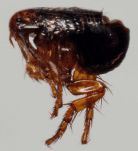 Flea
Flea
All adult fleas feed exclusively on the blood of their host. Fleas are mutual on well-nigh mammals, including cats, dogs and rodents. They are wingless and accept potent legs for jumping. Eggs from the female usually hatch in the nest or resting areas of the host. The eggs hatch in almost 10 days into tiny, worm-like white larvae that feed on flea excrement, skin scales and other debris. The larva crave a week to several months to consummate development before they pupate and emerge as adults. Adult fleas can survive for two to 4 months without a blood meal. Cat and domestic dog fleas will readily bite humans, especially when the normal host is absent-minded. When people go on holiday for a week or more, a big number of fleas can often be found waiting for the owners upon their return. Big numbers of fleas can also build upwards in yards. Fleas most ofttimes seize with teeth people on the legs and ankles. A pocket-sized red spot ordinarily appears at the bite site surrounded by a ruby halo with lilliputian swelling. Immature children tend to be more sensitive to flea bites than older children.
Chiggers:
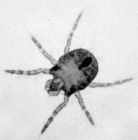 Chigger
The chigger is a tiny, scarlet mite that, in its immature phase, will feed on humans, rodents, birds, snakes and a wide variety of other animals. Chiggers are especially common in second growth areas, blackberry patches and woods edges. Chiggers are very active in itch well-nigh looking for a host, and may crawl over the skin for some hours before beginning to feed. When the mouthparts are inserted into the skin, a fluid is injected that dissolves the cells upon which it feeds. The chigger does non, as is ordinarily believed, burrow into the pare. Itching can begin iii to six hours afterwards exposure. Examination of the skin may reveal minute red mites moving near. A soapy bath taken equally soon equally their presence is noted will often remove many of them earlier they brainstorm feeding.
Ticks:
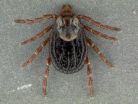 American Domestic dog Tick photo
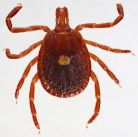 Lone Star Tick
The two nearly common ticks that feed on humans in Georgia are the American dog tick and the lone star tick. The woman tick drops from the host after a claret meal to lay her eggs. The eggs hatch and develop through three stages: the larva (sixlegged, very tiny — sometimes called a "seed tick"), the eight-legged nymph and the adult. During each of these three stages, the tick volition attach itself to a host, take a blood meal, then drop off to proceed the bicycle. All stages of the solitary star tick volition assault humans, simply only the adult phase of the American dog tick will. Both ticks feed on a broad diverseness of animals, although the American dog tick is especially common on dogs and the alone star tick on deer and livestock. Ticks are most mutual along trails and feeding and resting areas of their hosts. Both species tin can deport Rocky Mountain Spotted Fever (RMSF), a dangerous illness that causes a skin rash and high fever that may be mistaken for measles.
 Black-Legged Tick
The black-legged tick is less unremarkably found on people, but transmits Lyme disease. This disease initially has influenza-like symptoms and sometimes an expanding red rash at the bite site. Months or years later the disease can invade the neurological or cardiovascular system or joints of the body. Lyme affliction mimics other diseases, such as rheumatoid arthritis. The characteristic bull's-eye rash merely occurs in about 70 pct of the cases. Early on treatment with antibiotics is much more than effective than treatment months or years later on.
When in tick-infested areas, you should cheque your trunk (especially the dorsum of the head) at to the lowest degree twice a twenty-four hour period for ticks. Since embedded ticks demand 12 to 24 hours to transmit RMSF or Lyme affliction, early removal is a good preventative for these diseases. Embedded ticks should be removed with tweezers or wrapped in cloth or paper to avoid contact with the fingers. Grasp the tick as close to the peel equally possible and gently pull directly, but firmly, away from the pare. Immediately launder the bite site and your easily with hot, soapy water to minimize the chance of infection, as juices from an infected tick can transmit RMSF.
Spiders:
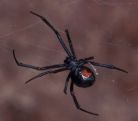 Blackness Widow Spider
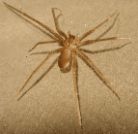 Dark-brown Recluse Spider
While spiders are beneficial in that they feed on diverse insects, there are at least two species in Georgia that are dangerous to humans. One is the black widow, which is very mutual throughout the land. It is shiny blackness with a reddish hourglass design nether the abdomen. This spider makes an irregular web in piles of trash and lumber, around rock borders and in cracks and crevices around the foundations of homes. The blackness widow is timid and will non usually bite unless handled. The other species is the brown recluse, which is extremely rare in Georgia. Its night violin-shaped marking is distinctive. This spider is also timid and seldom seen since it lives in undisturbed areas inside buildings (e.g., under the basement steps, in unused clothing) or exterior under rocks, piles of tires, under houses or under loose tree bark. The bite of the black widow is very painful, while the bite of the brown recluse can crusade a spreading ulcer that is slow to heal and can leave a scar. Suspected bites should be treated promptly by a doctor and the identification of the spider confirmed — your county Extension agent can help.
Command
Controlling fleas on pet dogs and cats greatly reduces the problem on people. Vacuuming pet resting areas at least twice a week in the house reduces all flea stages in the carpet and flooring. Aerosol sprays can be used to fumigate infested rooms. The inclusion of methoprene, a growth regulator, with an insecticide is the all-time combination for long-term control. Methoprene is slow in its activeness since it only stops the growth of the flea (the insecticide usually combined with it will give a quick kill). This method of control is a very safe and effective long-term solution. Diverse formulations of insecticide can be used in the yard. Read the characterization carefully for proper use. A repellent is often the most practical method of personal protection from chiggers and ticks due to the widespread areas in which they are establish. Repellents containing "DEET" are bachelor nether many brand names. Application to the peel or clothing volition commonly give several hours of protection. Those with a college percentage active ingredient normally concluding longer, just also often toll more. Permethrin (Permanone by make name) comes as an aerosol and is practical to the vesture only. It is effective in repelling and killing chiggers and ticks. Using "DEET" on the peel and permethrin on the clothing seems to requite the best protection, although either solitary tin be constructive.
Open, sunlit areas where the grass is cut brusque discourage ticks and chiggers because these areas are non humid plenty for their survival.
Reduce spiders by removing piles of wood and trash close to inhabited areas. Spot-care for infested areas with products labeled for this use.
Attention! Pesticide Precautions
Observe all directions, restrictions and precautions on pesticide labels. It is dangerous, wasteful and illegal to do otherwise. Avert pollinators and plants where pollinators are likely to occur.
- Store all pesticides in original containers with labels intact and behind locked doors. KEEP PESTICIDES OUT OF THE REACH OF CHILDREN.
- Use pesticides at correct characterization concentrations and intervals to avoid illegal residues or injury to plants and animals.
- Utilize pesticides carefully to avoid drift or contagion of non-target areas.
- Surplus pesticides and containers should be disposed of in accord with characterization instructions so that contagion of water and other hazards volition not consequence.
- Follow directions on the pesticide label regarding restrictions as required by country and federal laws and regulations.
- Avoid whatsoever action that may threaten an endangered species or its habitat. Your county extension agent tin inform yous of endangered species in your expanse, help yous place them, and through the Fish and Wildlife Service Field Office, place actions that may threaten endangered species or their habitat.
Refer to the current version of the Georgia Pest Management Handbook for appropriate and effective pesticide recommendations for all of the pests described in this publication.
Commercial: extension.uga.edu/publications/detail.cfm?number=SB28
Homeowner: extension.uga.edu/publications/detail.cfm?number=SB48
Photo Credits:
- Cicada Killer — Nancy Hinkle, University of Georgia, Bugwood.org
- Pipe Organ mud-dauber — Johnny N. Dell, Bugwood.org
- Pipe Organ Nest — Wikipedia, User: Pollinator
- Scorpion — Sturgis McKeever, Georgia Southern University, Bugwood.org
- Honey Bee — David Cappaert, Michigan State Academy, Bugwood.org
- Bumble Bee — David Cappaert, Michigan State University, Bugwood.org
- Umbrella Wasp on Nest — Joseph Berger, Bugwood.org
- Yellow Jacket — David Cappaert, Michigan State University, Bugwood.org
- Baldfaced Hornet — Johnny N. Dell, Bugwood.org
- European Hornet — Louis-Michel Nageleisen, Département de la Santé des Forêts, Bugwood.org
- Burn Pismire— Scott Bauer, USDA Agronomical Inquiry Service, Bugwood.org
- Puss Caterpillar — Herbert A. "Joe" Pase 3, Texas Forest Service, Bugwood.org
- Saddleback Caterpillar — Herbert A. "Joe" Pase III, Texas Forest Service, Bugwood.org
- Hag Moth Caterpillar — Jerry A. Payne, USDA Agricultural Inquiry Service, Bugwood.org
- Musquito — Pennsylvania Department of Conservation and Natural Resources, Forestry Archive, Bugwood.org
- Deer Fly — Sturgis McKeever, Georgia Southern University, Bugwood.org
- Horse Fly — Sturgis McKeever, Georgia Southern University, Bugwood.org
- Biting Midge — Ed T. Schmidtmann, USDA/ARS
- Black Wing — Entomology and Plant Pathology, Oklahoma State University
- Flea — Joseph Berger, Bugwood.org
- Chigger — Hansell F. Cross, Georgia State University, Bugwood.org
- American Dog Tick — Gary Alpert, Harvard University, Bugwood.org
- Lone Star Canis familiaris Tick — Susan Ellis, USDA APHIS PPQ, Bugwood.org
- Black-legged Tick — Scott Bauer, USDA Agronomical Inquiry Service, Bugwood.org
- Black Widow — Sturgis McKeever, Georgia Southern University, Bugwood.org
- Brown Recluse — Lisa Ames, University of Georgia, Bugwood.org
- Cover Photos — Photobucket.com
Condition and Revision History
Published on Jan 01, 2002
Published on Mar 30, 2009
Published with Minor Revisions on Apr xviii, 2012
Published with Minor Revisions on May 11, 2015
Source: https://extension.uga.edu/publications/detail.html?number=C782&title=Stinging%20and%20Biting%20Pests
0 Response to "Which Insect in the Wasp Family Is Very Small but Stings Like a Yellow Jacket"
Post a Comment