Sociological Studies of Patterns of Family Violence Have Found That:
The Functionalist Perspective
Functionalists view the family unit equally a construct that fulfills important functions and keeps society running smoothly.
Learning Objectives
Explicate the social functions of the family through the perspective of structural functionalism
Key Takeaways
Key Points
- Functionalists place a number of functions families typically perform: reproduction; socialization; intendance, protection, and emotional support; assignment of condition; and regulation of sexual behavior through social norms.
- For functionalists, the family unit creates well-integrated members of society by instilling the social culture into children.
- Radcliffe-Brownish proposed that most stateless, "primitive" societies, defective strong centralized institutions, are based on an association of descent groups. These clans emerge from family units.
Key Terms
- family: A group of people related by blood, marriage, law or custom.
- Radcliffe-Brown: A British social anthropologist from the early twentieth century who contributed to the development of the theory of structural-functionalism.
- institution: An established organization, especially one defended to education, public service, culture, or the care of the destitute, poor etc.
Structural functionalism is a framework that sees society every bit a complex system whose parts work together to promote solidarity and stability. In this manner, society is like an organism and each attribute of social club (institutions, social constructs, etc.) is like an organ that works together to keep the whole functioning smoothly. This approach looks at society through a macro-level orientation, which is a wide focus on the social structures that shape club as a whole. Functionalism addresses society in terms of the function of its constituent elements: norms, customs, traditions and institutions. Functionalists, in general, identify a number of functions families typically perform: reproduction; socialization; care, protection, and emotional support; assignment of condition; and regulation of sexual behavior through the norm of legitimacy.
The Family
Radcliffe-Brown proposed that about stateless, "primitive" societies that lack strong centralized institutions are based on an association of corporate-descent groups. Structural functionalism also took on the argument that the basic edifice block of society is the nuclear family, and that the association is an outgrowth, not vice versa. Durkheim was concerned with the question of how sure societies maintain internal stability and survive over time. Based on the metaphor above of an organism in which many parts function together to sustain the whole, Durkheim argued that complicated societies are held together by organic solidarity.

Nuclear Family: Structural functionalism also took on the argument that the basic building block of gild is the nuclear family, and that the association is an outgrowth, non vice versa.
Functions of the Family
For functionalists, the family unit creates well-integrated members of society and instills civilisation into the new members of society. It provides important ascribed statuses such every bit social class and ethnicity to new members. It is responsible for social replacement past reproducing new members, to replace its dying members. Further, the family gives individuals holding rights and also affords the assignment and maintenance of kinship order. Lastly, families offering material and emotional security and provides care and support for the individuals who need care.

Expectant Family: Family expecting an additional family member.
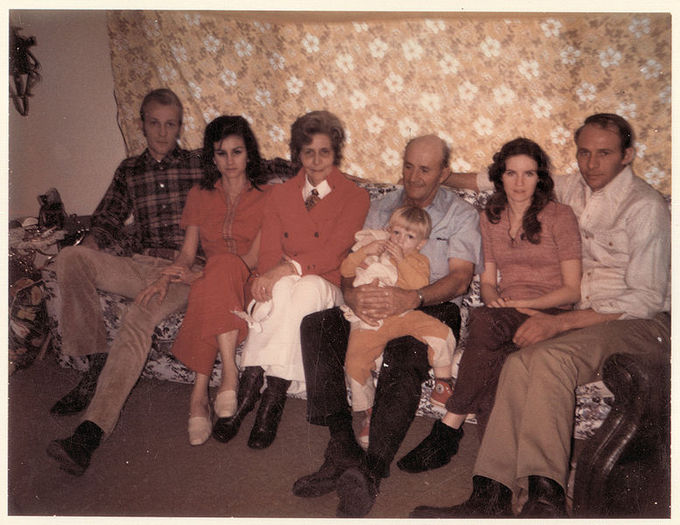
Family in the 1970s: For functionalists, the family creates well-integrated members of society and teaches culture to the new members of society.
The Disharmonize Perspective
The conflict perspective views the family equally a vehicle to maintain patriarchy (gender inequality) and social inequality in social club.
Learning Objectives
Analyze the family from the perspective of conflict theory
Fundamental Takeaways
Central Points
- The disharmonize perspective describes the inequalities that be in all societies globally, and considers aspects of society equally ways for those with power and status to maintain command over scare resource.
- According to conflict theorists, the family works toward the constancy of social inequality within a society by maintaining and reinforcing the condition quo.
- Through inheritance, the wealthy families are able to keep their privileged social position for their members.
- Disharmonize theorists have seen the family as a social arrangement benefiting men more than women.
Primal Terms
- family: A grouping of people related by blood, matrimony, law or custom.
- inheritance: The passing of title to an estate upon death.
- Conflict Perspective: A perspective in the social sciences that emphasizes the social, political or fabric inequality of a social group; critiques the broad socio-political system; or otherwise detracts from structural functionalism and ideological conservativism.
The Conflict perspective refers to the inequalities that exist in all societies globally. Conflict theory is particularly interested in the diverse aspects of master condition in social position—the primary identifying characteristic of an private seen in terms of race or ethnicity, sexual activity or gender, age, religion, ability or inability, and socio-economic status. According to the Disharmonize paradigm, every society is plagued past inequality based on social differences among the ascendant group and all of the other groups in society. When we are analyzing any chemical element of order from this perspective, we need to look at the structures of wealth, power and status, and the means in which those structures maintain social, economical, political and coercive power of one group at the expense of others.
The Family
According to conflict theorists, the family unit works toward the continuance of social inequality within a society by maintaining and reinforcing the status quo. Considering inheritance, education and social capital are transmitted through the family unit construction, wealthy families are able to proceed their privileged social position for their members, while individuals from poor families are denied similar status.
Conflict theorists have too seen the family as a social organization benefiting men more than than women, allowing men to maintain a position of power. The traditional family form in about cultures is patriarchal, contributing to inequality between the sexes. Males tend to have more ability and females tend to take less. Traditional male roles and responsibilities are valued more than the traditional roles washed past their wives (i.e., housekeeping, child rearing). The traditional family unit is also an inequitable structure for women and children. For example, more lx per centum of all mothers with children nether vi are in the paid workforce. Even though these women spend as much (or more) fourth dimension at paid jobs as their husbands, they also practise more of the housework and child care.

Chinese Family in Suriname: According to conflict theorists, the family works toward the continuance of social inequality inside a society past maintaining and reinforcing the condition quo.
The Symbolic Interactionist Perspective
Symbolic interactionists view the family unit as a site of social reproduction where meanings are negotiated and maintained by family members.
Learning Objectives
Analyze family unit rituals through the symbolic interactionalist perspective
Key Takeaways
Key Points
- Symbolic interactionism is a theory that analyzes patterns of communication, interpretation, and adjustment between individuals in society. The theory is a framework for understanding how individuals interact with each other and within society through the meanings of symbols.
- Office-taking is a primal mechanism that permits an individual to appreciate another person's perspective and to understand what an activeness might mean to that person. Part-taking emerges at an early age through activities such as playing firm.
- Symbolic interactionists explore the irresolute meanings attached to family. Symbolic interactionists argue that shared activities help to build emotional bonds, and that marriage and family unit relationships are based on negotiated meanings.
- The interactionist perspective emphasizes that families reinforce and rejuvenate bonds through symbolic rituals such equally family meals and holidays.
Key Terms
- family: A grouping of people related by blood, union, law or custom.
- ritual: Rite; a repeated set of actions
- bonds: Ties and relationships between individuals.
Symbolic interactionism is a social theory that focuses on the assay of patterns of communication, interpretation, and aligning between individuals in relation to the meanings of symbols. According to the theory, an individual'due south verbal and nonverbal responses are synthetic in expectation of how the initial speaker will react.
This emphasis on symbols, negotiated meaning, and the construction of society every bit an aspect of symbolic interactionism focuses attention on the roles that people play in society. Role-taking is a key mechanism through which an individual tin appreciate another person'due south perspective and improve understand the significance of a particular action to that person. Role-taking begins at an early age, through such activities equally playing firm and pretending to be unlike people. These activities have an improvisational quality that contrasts with, say, an actor's scripted role-playing. In social contexts, the uncertainty of roles places the burden of role-making on the people in a given situation.
Ethnomethodology, an adjunct of symbolic interactionism, examines how people'south interactions can create the illusion of a shared social order despite a lack of mutual understanding and the presence of differing perspectives. Harold Garfinkel demonstrated this state of affairs through so-chosen experiments in trust, or breaching experiments, wherein students would interrupt ordinary conversations because they refused to take for granted that they knew what the other person was saying.
The Family
Symbolic interactionists also explore the changing meanings attached to family. They fence that shared activities help to build emotional bonds amongst family unit members, and that marriage and family relationships are based on negotiated meanings. The interactionist perspective emphasizes that families reinforce and rejuvenate bonds through symbolic machinery rituals such as family meals and holidays.

The Family: Symbolic interactionists explore the changing meanings fastened to family. They contend that shared activities assist to build emotional bonds and that marriage and family relationships are based on negotiated meanings.
The Feminist Perspective
Feminists view the family as a historical establishment that has maintained and perpetuated sexual inequalities.
Learning Objectives
Describe the goals of first and second-wave feminism
Key Takeaways
Cardinal Points
- Feminism is a broad term that is the issue of several historical social movements attempting to proceeds equal economic, political, and social rights for women.
- First-moving ridge feminism focused mainly on legal equality, such as voting, instruction, employment, the wedlock laws, and the plight of intelligent, white, middle-grade women.
- Second-wave feminism went a step farther is seeking equality in family unit, employment, reproductive rights, and sexuality.
- Both feminist and masculinist authors have decried predetermined gender roles as unjust.
Key Terms
- gender: The socio-cultural phenomenon of the sectionalisation of people into diverse categories such as male person and female, with each having associated roles, expectations, stereotypes, etc.
Feminism is a broad term that is the result of several historical social movements attempting to gain equal economic, political, and social rights for women. Beginning-wave feminism focused mainly on legal equality, such as voting, didactics, employment, marriage laws, and the plight of intelligent, white, middle-class women. Second-wave feminism went a step further by seeking equality in family unit, employment, reproductive rights, and sexuality. Although at that place was neat improvements with perceptions and representations of women that extended globally, the movement was not unified and several unlike forms of feminism began to emerge: black feminism, lesbian feminism, liberal feminism, and social feminism.
Sociology of Motherhood
In many cultures, peculiarly in a traditional western ane, a mother is normally the married woman in a married couple. Her role in the family is celebrated on Mother's Twenty-four hour period. Some frequently view mothers' duties as raising and looking subsequently their children every infinitesimal of every day. Mothers ofttimes have a very important part in raising offspring, and the championship can exist given to a non-biological mother that fills this role. This is common in stepmothers (female married to biological father). In most family structures, the female parent is both a biological parent and a main caregiver.
However, this limited role has increasingly been called into question. Both feminist and masculist authors have decried such predetermined roles as unjust. In the The states, 82.v meg women are mothers of all ages, while the national boilerplate age of kickoff kid births is 25.ane years. In 2008, x% of births were to teenage girls, and 14% were to women ages 35 and older.

Women'south Rights: International Women'south Day rally in Dhaka, People's republic of bangladesh, organized past the National Women Workers Trade Union Centre on March 8, 2005.
Source: https://courses.lumenlearning.com/boundless-sociology/chapter/sociological-perspectives-on-family/
0 Response to "Sociological Studies of Patterns of Family Violence Have Found That:"
Post a Comment